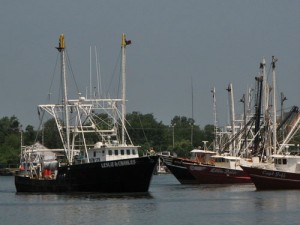
Virginia commercial fishermen harvest blue crabs, sea scallops, oysters, hard clams, lobsters, menhaden, flounder, monkfish, spot, croakers, trout, drum, striped bass, black sea bass, hake, cod, mackerel, catfish, swelling toads, tuna, sharks, and other seafood.
Blue crabs are an important species for Virginia commercial fishermen. Blue crabs are caught with crab pots, trot lines, or other methods.
Watermen also harvest shedder crabs, known locally as peeler crabs. Commercial crabbers or buyers cultivate the crabs in special floats until they molt (shed). Soft shelled crabs are sold as a local delicacy or to shipped to regional markets.
Virginia is known for its oyster industry, which includes both wild and farmed products. In the Chesapeake Bay, commercial watermen harvest oysters mainly by power dredging. In the coastal bays, watermen harvest oysters by hand.
Commercial harvests of sea scallops are landed by limited entry boats, fishing out of Newport News Seafood Industrial Park and other Hampton Roads area ports.
Virginia is known for its hard clams (quahogs), both wild caught and farm-raised. Independent clammers harvest wild clams by hand much as it was done 100 years ago. Commercial fishermen also use patent tong rigs to catch wild hard clams in waters of the Chesapeake Bay.
Clam aquaculture operations grow clams from seed up to 1-2″ which are prized for steaming or eaten raw.
The Virginia lobster fishery consists of traps set along the continental shelf slopes, mostly found in depths of 40-100 fathoms (240-600 feet). Markers or “lobster balls” denote each end of a series of 25-30 lobster traps. The groups of traps, known as “pots” are baited and fished after soaking for up to 10 days. The catch is kept in tanks and sold live.
A red crab fishery exists off the coast of Virginia. The red crab fishery is made up of a very small number of boats that hold permits to catch and process these shellfish.
Red crabs are difficult to catch and are said to be harvested only in a very narrow band of depth that centers around 500 fathoms. Red crabs are caught with large traps, similar to those used in the Alaska king crab and Snow crab fisheries.
The Virginia commercial fishery for menhaden is the largest on the Atlantic Coast. The vast majority of menhaden are landed by purse seine vessels, owned by Omega Protein and operating out of Reedville.
Throughout Virginia, small scale operations harvest mixed species using gillnets, pound nets, and other gear.
In federal waters off the coast, trawlers, longliners, and other fishermen harvest flounder, red hake, black sea bass, monkfish, tuna, mahi, swordfish, and other fish.
A trap fishery exists for black sea bass, conducted around shipwrecks and areas of rough bottom. Another trap fishery along Virginia coastal waters targets whelk, known locally as “conch.” Jonah crabs, a bycatch of trap fisheries, is a niche fishery.
Virginia is one of several Mid Atlantic states that have experienced changes in fisheries due to warmer waters. In 2021, Virginia approved a coastal fishery for warmwater shrimp. The limited-entry fishery takes place in near shore state waters in late fall and winter. Fishermen harvest white and brown shrimp, which are marketed locally.
Related Information